
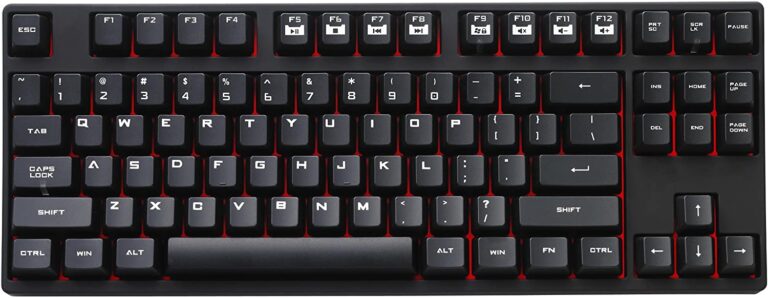

10 TOP Keyboard for Programming & Coding
Programmers work on a computer for the most of their days, developing, writing, and testing code. As a result, the keyboard is one of their most important tools. A programmer can’t just pick any keyboard and hope it works. They’re looking for one that will make their job easier. A keyboard that they can type on all day without tiring, as well as reconfigure to quickly access their most frequently used applications on their computers.
An excellent keyboard should reduce the amount of time you spend using the mouse and, as a result, increase your productivity. We don’t need many tools to work as builders; many would argue all we need is a laptop or computer. While this is true, there’s a difference between having the bare minimum and having the equipment you’ll need to work comfortably, productively, and healthily.
We’re going to discuss about keyboards that you’d enjoy using as a developer right now. I’m providing you with my personal opinion on the keyboards as well as some facts in the form of a list that isn’t in any particular order. Which keyboard is the best? The one that best suits your needs! Let’s get right into the list now that it’s out of the way.
Keychron K6 Wireless Mechanical Keyboard

Wireless Mechanical Keyboard Keychron K6 Let’s start with my favorite keyboard, the keychron k6, which I’m using right now to write this article. I have the RGB model with brown switches, which I enjoy. To begin with, I like the format; for me, 65 percent keyboards is the right measurement. I like the arrow keys, but I don’t want the numeric keyboard on the right side, nor do I want a distinct space for the home and web page keys.
The keyboard is of excellent quality, feels very solid, and is extremely comfortable; however, it is a little high, so I recommend using a palm rest (I take advantage of their official palm relaxation, which is all wooden and fairly cool). It supports a variety of Bluetooth devices, which is a feature I use on a daily basis, just as I do with the keyboard on my personal laptop and my work computer. It has a large 4000mAh battery that lasts a long time without needing to be charged, yet I keep it plugged in for convenience.
I like that I have to exert some force on the keys to make a keystroke, and I enjoy the trip of the keys. It allows me to type far faster than I could with other keyboards. Although, to be honest, I’m a huge lover of brown switches in general. Last but not least, it supports Windows, Linux, and Mac, and it even comes with a separate set of keys for Mac and Windows, allowing you to customize it to your desire. **If you are exploring a 75% keyboard for programming, the K6’s 65% footprint is the next step down — you gain even more desk space but lose the dedicated function row.** For developers who frequently use F-keys in IDEs, a 75% keyboard like the Keychron K8 Pro may be the better middle ground between compactness and full functionality.
Apple Magic Keyboard

Magic Keyboard by Apple The Apple magic keyboard, which comes in a variety of sizes, is a popular choice among builders. You’ll note that this keyboard is almost everyone’s default keyboard at Google and Facebook. It’s a great keyboard, with the Apple quality you’d expect, and it’s almost certainly a no-brainer for people who own a Mac.
Though I know a lot of people who love this keyboard, I’m not a big fan. I have one, but I can’t use it. The journey of the keys is just too brief, and after typing on that keyboard, I believe it is far too sensitive. In addition, I use Linux, thus I need a keyboard that can help me navigate that environment. **For Mac developers who value a seamless multi-device workflow, the Magic Keyboard remains a low-profile wireless keyboard option worth considering — though it lacks the hot-swappable switches and QMK/VIA programmability that mechanical keyboard enthusiasts prioritize.**
Ducky One 2 SF
 Ducky One 2 SF This keyboard is a masterpiece. It’s additionally a mechanical, RGB, 65% keyboard. It’s built with wonderful high quality, the way in which the keyboard feels is wonderful and I used to be extraordinarily proud of it, till I broke it :(, horrible accident on my side.
There are 2 downsides to this keyboard, it isn’t wireless, and it’s on the costly side, nevertheless it compensates with programmable macro keys, wonderful structure, tremendous comfy, and appears superior! And did I point out that it comes with Cherry MX switches? What to not love about that. **The Ducky One 3 series has since succeeded the One 2 SF, and it remains one of the best TKL options for coding thanks to its excellent stock keycaps, hot-swappable PCB, and near-universal praise for build quality among developer communities.**
Das Keyboard 4

4th Keyboard I didn’t buy this keyboard, but I did give it a try. The scale is the reason why I never bought it. It’s a full-size keyboard, and I’m not a huge lover of full-size keyboards. Aside from that, the keyboard is well-constructed.
It’s comfortable to use and feels right while typing. It has cherry MX switches, which I like, and it doesn’t have a backlight. Overall, it’s a decent keyboard, but it’s not my style. **If you need a numpad for data-heavy work but still want mechanical switches for programming, the Das Keyboard 4 remains a durable, no-frills choice — though its lack of hot-swap sockets and QMK support makes it less future-proof than newer alternatives.**
Kinesis Freestyle Edge
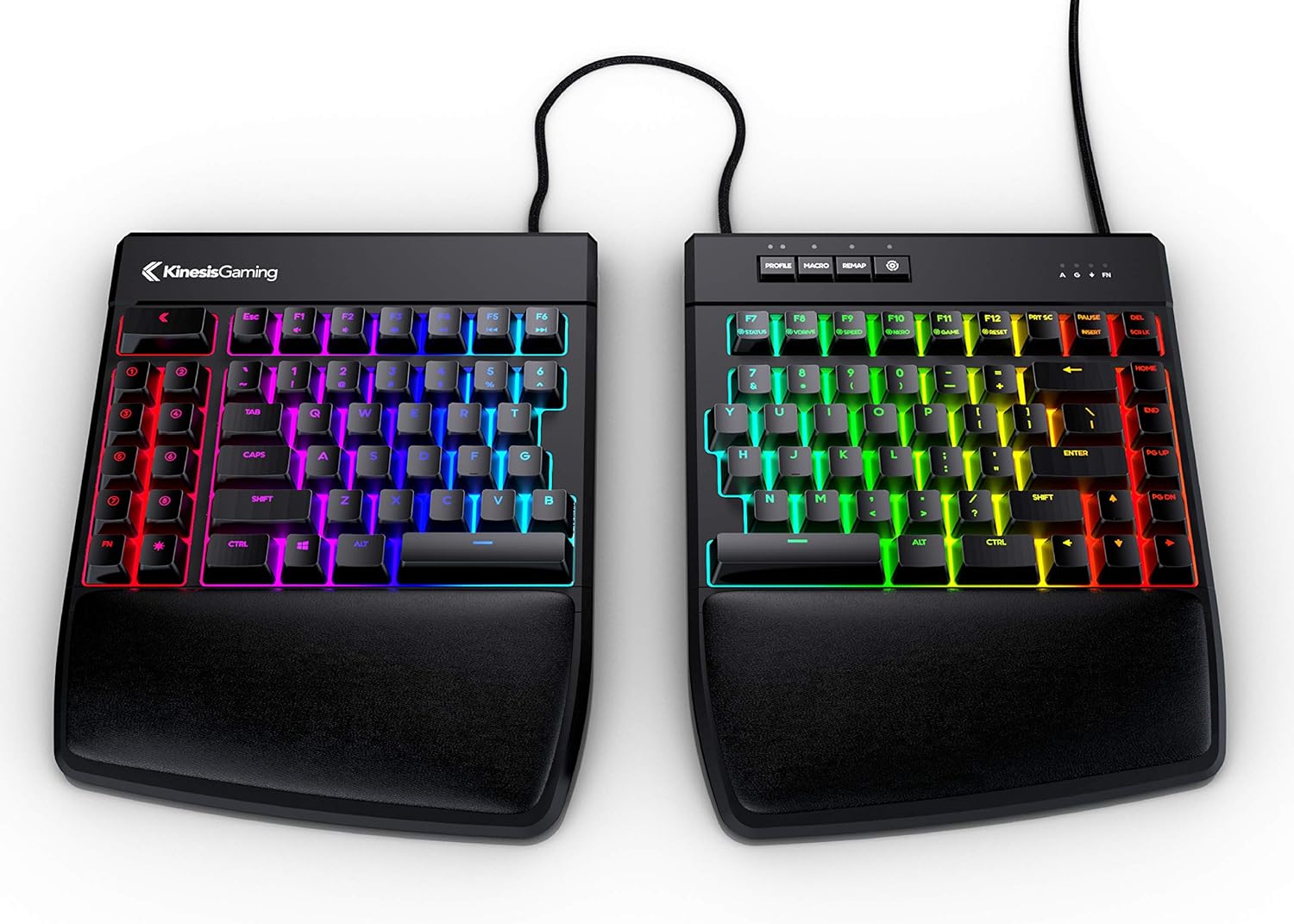
Freestyle Kinesis Kinesis Kinesis Kinesis Kinesis Kines The kinetic freestyle edge isn’t your typical keyboard. You’ll rarely see one of these on a desk, and if you do, you’ll almost certainly inquire about it with the proprietor. Its slashed structure immediately grabs our attention because it’s something we’re not used to.
Customers of this style of keyboard, on the other hand, claim that it allows them to type extremely quickly and comfortably. This keyboard, in particular, has cherry MX switches, RGB illumination, and programmable keys. On the downside, it takes some time to get used to, but once you do, it promises good results. **For programmers experiencing early signs of RSI or carpal tunnel syndrome, a split ergonomic keyboard like the Freestyle Edge can be a career-saving investment — it allows each hand to rest at a natural shoulder-width distance, reducing the ulnar deviation that standard keyboards force.**
Microsoft Sculpt Keyboard

Sculpt Keyboard by Microsoft Microsoft isn’t known for its hardware, but they excel at keyboards, as evidenced by the Microsoft Sculpt Keyboard. I used to use this keyboard a lot as my office keyboard a few years ago. It’s not exactly a portable keyboard, but it’s quite comfortable, and I can type extremely quickly with it.
Its peculiar ergonomic form distinguishes it, and despite the fact that it looks to be very strange, I quickly adapted to it. It’s a decent choice for an office keyboard for those who use Windows or Linux, and while it’s not one I’d personally choose, it’s one I’ve recommended to a number of people who have been very pleased with their purchases. **The Sculpt remains one of the best budget ergonomic keyboards for programmers who want to test a split layout without committing to a $400+ Kinesis or Dygma. Its membrane switches are quiet enough for open offices, and the detachable numpad lets you position the mouse closer to your body.**
Corsair K100 RGB Mechanical Gaming Keyboard
 Corsair K100 RGB Mechanical Gaming Keyboard This keyboard is all about efficiency. It’s a ridiculously quick keyboard which makes it excellent for gaming. It additionally features many customization choices, from macro keys to the multi-function iCUE control wheel, absolutely programmable.
This keyboard is a top edge keyboard, maybe not the best choice if you’ll simply use it for programming as it’s fairly costly, however a implausible keyboard. I used to be actually hesitant so as to add it to the list as its most important advantages are round gaming. However, a few of my gaming programmer associates love this keyboard and talked about that it’s value it. Me personally? I don’t play a lot, maybe often AoE II DE, so I don’t want a flowery gaming keyboard, and for the worth, I positively will keep out of this one. Should you suppose it’s a good choice for you:
Logitech MX Keys
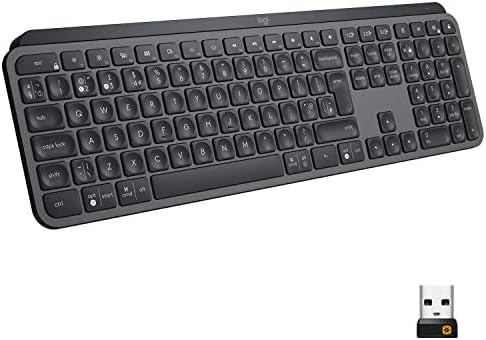 Logitech MX Keys Final on the list a keyboard specifically designed for builders. It’s not a mechanical keyboard. However, it’s fairly comfy to type (and fewer noisy than mechanical counterparts). Though it’s a full-size keyboard, it’s fairly compact and has Home windows, Linux, and Mac modes. It’s a wireless keyboard and has wonderful battery life lasting as much as 10 days whereas utilizing the backlight and as much as 5 months without it.
As anticipated from Logitech, you should use their software program to customize the keyboard, and you’ll join as much as 3 totally different gadgets on wireless mode utilizing Bluetooth. It’s a nice choice and really inexpensive contemplating it an excellent keyboard. **For developers who split their day between a Mac at the office and a Windows PC at home, the MX Keys’ three-device Bluetooth switching and Logitech Flow support make it one of the best wireless keyboards for coding across multiple operating systems.** (The newer Logitech MX Mechanical adds low-profile mechanical switches to this same multi-device formula for those who want tactile feedback without the bulk.)
Best Keyboards for Programmers Listing
| Product | Kind | Type Issue | Swap Kind | Wireless | Motive Chosen | Particulars |
|---|---|---|---|---|---|---|
| Microsoft Sculpt Ergonomic Keyboard | Membrane | Tenkeyless | N/A | Sure | Best Budget Ergonomic keyboard | Check Price |
| Das Keyboard 4 Professional Keyboard | Mechanical | Full measurement | Cherry MX Brown | No | Best Sensible Keyboard | Check Price |
| Kinesis Advantage2 Keyboard | Mechanical | Tenkeyless | Cherry MX Brown | Sure | Best Ergonomic Keyboard Overall | Check Price |
| CM Storm QuickFire Rapid | Mechanical | Tenkeyless | Cherry MX Brown | No | Best Mechanical Keyboard | Check Price |
| Happy Hacking Professional2 Keyboard | Mechanical | Compact | Topre | No | Best Transportable Keyboard | Check Price |
Microsoft Sculpt Keyboard – Best Budget Ergonomic Keyboard
Microsoft Sculpt is a programming keyboard that I strongly recommend for workplace ergonomics. It’s a lot easier to use than the Kinesis, and it’s a lot less expensive. However, because they use completely different approaches, comparing them could be unfair. Unlike the Kinesis, this coding keyboard divides the keys into two by removing the cloth between them completely. The motivation behind it, though, is the same. To type with your fingers and arms in a more natural position while reducing the amount of pressure used. And it does so admirably.
I had a lot easier time typing on this keyboard than on the Kinesis, although it still takes some time to get used to. Another thing I like is the destructive bent. It’s not like the forward raise on most keyboards, but it’s surprisingly comfortable. It’s further bolstered with a padded wrist rest that prevents you from overbending your wrist.
The palm relaxation is magnetically attached to the keyboard, and you may remove it if you prefer to type on your lap. And, what’s more, the lean can be adjusted. You can try out several heights to see which one is most comfortable for you. The keys are also slightly larger than those on typical keyboards. As a result, there have been far fewer typing errors, which I can report.
The majority of my mistakes stemmed from a lack of familiarity with the keyboard. The dedicated num pad, on the other hand, has to be my favorite feature of the Microsoft Sculpt. The main reason I don’t use the num pad is because of its inconvenient placement. To succeed, I’ll have to push myself. I can now store it in a more convenient location. The keypad is quick to respond and feels like it belongs on both a laptop and a desktop. Because this is one of the greatest coding keyboards, you won’t have to worry about tangles.
Das Keyboard 4 Professional Mechanical Keyboard – Best Sensible Keyboard
Because of the aluminum top panel, this keyboard is without a doubt one of the most durable I’ve tested. I say this because I applied a lot of force to it in an attempt to bend it, and it handled it admirably. While it may not be the wisest course of action, it’s safe to assume that this keyboard can withstand a few drops.
The mechanical keyboard for programming has switched from the familiar Cherry MX switches to gamma Zulu switches. They claim that these switches will last for up to 100 million keystrokes. That’s rough twice as much as the MX. I cannot confirm this, but I can attest to the fact that they definitely feel very different.
They’re softer, and they resemble a mix of black and brown Cherry MX switches. Wrist relaxation is one of my favorite features on this keyboard. It’s quite comfortable, and it made me type a little faster. The volume knob and three dedicated media keys on the right side of the keyboard are also useful for controlling media on your computer. What’s more, you may now designate each of the 12 operation keys to a distinct task.
The volume knob, on the other hand, was a bit thick and difficult to work with. But first, let’s address the most important question. Why is this keyboard regarded as excellent? It works well with the IFTT protocol or the ‘IF THIS THEN THAT’ protocol in any scenario. You may program a number of keys to alert you when there is activity on the internet or in your immediate vicinity.
You could, for example, have it notify you whenever a new touch is made on a discussion you’re following on Stack Overflow. Or, in a more practical example, I programmed it to notify me when my phone rang. While coding, you won’t hear it ring, but you won’t miss the blinking keys. They’ve utilized laser etching to name their keyboards, so there’s no chance of them being stolen.
Kinesis Advantage2 Keyboard – Best Ergonomic Keyboard Overall
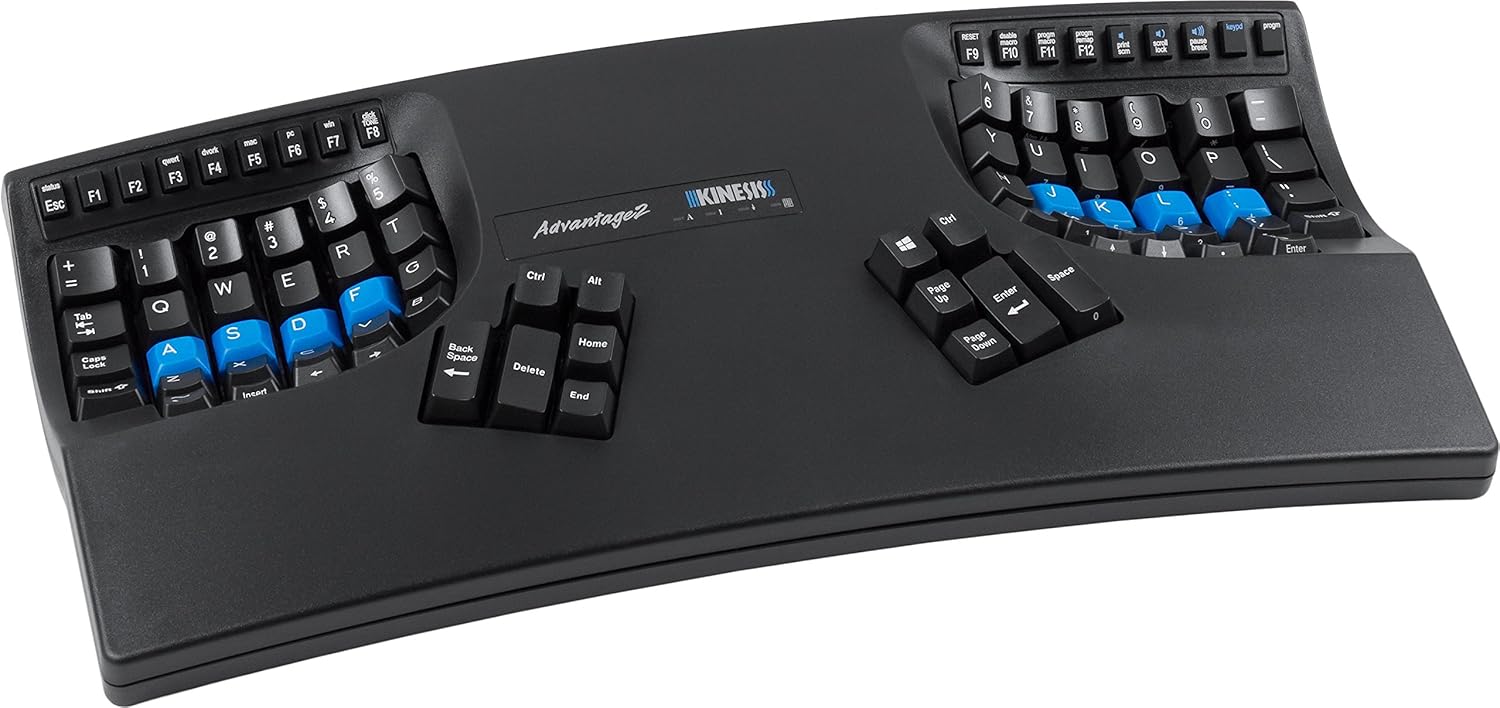
If you suffer from wrist pain on a regular basis, I strongly recommend the Kinesis Advantage2. It is without a doubt one of the greatest keyboards for programmers, with a unique design that combines several techniques to help you use the keyboard comfortably for long periods of time.
On each side of the keyboard, the keys have been split in half and positioned in a contour. I wasn’t sure how this would help until I started typing. It will improve my thumb performance by introducing two thumb clusters to begin with. The CTRL, Enter, and Area keys are in the correct cluster, as is the Backspace and Escape keys.
On the left cluster, you’ll find the Delete and Alt buttons. In addition, my arms felt so natural in their position that I could type all day. And not just my wrists, but also my shoulders. My arms stretch straight from the shoulder instead of the usual V, thanks to the sliced up design.
I won’t lie: typing on this keyboard is difficult, and it can take some time until you’re back to typing at your normal speed. However, once you’ve done so, you’re not going back. If you’re having trouble adjusting to their structure, the keyboard has a useful programming engine with inbuilt remapping that you should utilize to change the buttons.
It allows you to alter the important thing sequence in a hundred different ways. You can save each new structure you make and attach any alphabetic key to it as a hotkey for quick access. The main response is likewise outstanding, but I wouldn’t have expected anything less given that it makes use of Cheryl MX Brown switches.
It is without a doubt one of the greatest programming keyboards available, as it is compatible with both Windows PC and Mac computers and does not require any special drivers to use. **For programmers with existing RSI or carpal tunnel symptoms, the Advantage2’s contoured keywells and thumb clusters are widely regarded as the gold standard for ergonomic relief — competitors like the Kinesis Advantage360 Professional and Dygma Defy have built on this formula with wireless connectivity and hot-swappable switches, but the Advantage2 remains the most proven entry point into contoured ergonomic keyboards.**
CM Storm QuickFire Rapid – Best Mechanical Keyboard

You’ve probably heard everyone talking about mechanical keyboards and are wondering why there’s such a fuss. So, I urge that you try the CM Storm QuickFire Fast so that you can be the one to talk. What makes it so appealing?
Let’s start with the measuring of it. They’ve reduced the size of this mechanical keyboard for coding by completely removing the Num pad. This change is beneficial because it allows me to access the mouse more easily and frees up space on my workspace.
To be honest, I don’t use the Num pad very much. The brown Cherry MX mechanical switches on this programmer keyboard make typing a real pleasure. I used to be able to type faster and use less electricity since this type of switch registers a key stroke before it reaches the bottom. The keys on this coder keyboard are laser engraved, so they should be able to withstand a lot of pounding without wearing out.
I also appreciate that the connected connections are detachable. It would have been good if the keyboard was completely wireless, but at the very least you no longer have to fold the cord across the keyboard when carrying it about. If you’re using an older computer model, it also allows you to use the PS/2 port.
It’s also advantageous since, if the cable develops a problem, you can use it instead of the keyboard. PS/2 users will benefit from the N-Key rollover option, which allows you to press multiple keys at once. This is similar to the anti-ghosting feature that is currently available for USB connections. I type really quickly and frequently find myself pressing the next button before I’ve finished the previous one.
Because of these features, it’s possible that each key I hit will be recorded. In addition to the QuickFire, the bundle includes some extra keys and a key cap puller. These keys may not be as useful for programmers as they are for gamers, but I think they’re useful since they introduce you to the concept of key customization.
Some programmers dislike having too much detail on their keys, therefore this developer keyboard allows you to replace the stock keys with more useful ones. I tried removing the keycaps with the keycap remover, and it’s a rather simple procedure. It is without a doubt one of the greatest keyboards for coding, with purple and blue switches available. **The QuickFire Rapid’s detachable cable and tenkeyless form factor make it a solid budget pick for programmers who want a portable mechanical keyboard, but if hot-swappable switches and QMK/VIA support are on your must-have list, the Keychron K8 Pro or Keychron V1 are more modern alternatives at a similar price point.**
Happy Hacking Professional2 Keyboard – Best Transportable Keyboard

In terms of design, this keyboard follows a very simple approach. In addition to removing the num pad, it also removes the navigation and operation keys above it, making the keyboard smaller than the Tenkeyless keyboard. And the first thing I noticed was how much less pressure I put on my arms when typing. It also frees up a lot of space on my desk and makes using my mouse a breeze.
The fact that they didn’t try to make the keys smaller is a plus. The crucial response can also be instantaneous, which is most likely due to the use of high-quality Topre switches. Because the topre switches are a hybrid of membrane and mechanical keyboards, it isn’t as noisy as a traditional mechanical keyboard.
When the switch bottoms out, though, you can still hear the click, which is exactly what I want. I should warn you that getting used to this developer keyboard may take some time. There have been a few changes in critical positions. Caps, for example, is shared with the Tab button, while Ctrl is used in its place. It has Delete as an alternative to backspace.
However, you may change this again and control the motion of other specific keys using the DIP switches on the rear. On the rear, there is literature that explains what each switch does. Although the matte key labels on a dark gray background may be difficult to notice, I’m confident that this keyboard for typing will appeal to individuals who dislike having too much color on their keys. **The HHKB Professional Hybrid Type-S is the modern successor to this keyboard, adding Bluetooth connectivity and silencing rings while preserving the beloved Topre feel and Unix-centric layout that makes it a cult favorite among Vim and terminal-first developers.**
75% vs TKL vs 65%: The Best Layout for Coding in 2026
Layout is arguably the single most consequential keyboard decision a programmer makes — more than switch type, more than brand. The three layouts that dominate developer discussions are **75%**, **TKL (tenkeyless)**, and **65%**. Each represents a different trade-off between desk space, key accessibility, and muscle-memory compatibility.
**The 75% keyboard for programming** has emerged as the consensus “sweet spot” among working developers in 2026. It retains the function row (F1–F12) and a dedicated arrow cluster while eliminating the numpad. This means you can trigger IDE shortcuts, debugger controls, and browser DevTools without reaching for a Fn-layer combination. A programmer on a long-running r/MechanicalKeyboards thread put it plainly: “As long as the arrow keys are 1u you will be fine as soon as your muscle memory remembers where they are” . For coders who live in VS Code, IntelliJ, or Vim and rely on function-key shortcuts, a 75% board avoids the “missing key” friction that 60% and 65% layouts introduce.
**TKL (tenkeyless)** keeps the full function row, arrow cluster, and navigation cluster (Insert/Home/PgUp/PgDn) as dedicated keys, but drops the numpad. It is the most forgiving choice for developers who context-switch between different keyboards throughout the day — the muscle memory transfers cleanly because nothing is hidden behind layers. The trade-off is roughly 3 cm of extra desk width compared to a 75% board, which matters if you push your mouse close to your keyboard hand during long editing sessions .
**65% keyboards** (like the Keychron K6 reviewed above) remove the function row and navigation cluster, retaining only arrows and a few essential modifiers. They are the most compact option that still feels usable for general productivity, but programmers who depend on F-keys for debugging or window management often find themselves reaching for Fn combinations more often than they’d like.
**The practical recommendation for most developers:** start with a **75% or TKL layout**. Both preserve the keys you use most in an IDE without forcing layer memorization. If desk space is non-negotiable and you primarily code in a terminal-centric environment (where F-keys matter less), a 65% board is viable. Avoid 60% layouts as a first programming keyboard unless you are prepared to remap extensively .
QMK and VIA: Why Programmability Matters for Developers
The feature that separates a “good” programming keyboard from a “great” one in 2026 is not switches or keycaps — it is **firmware-level programmability**. Competitors across the board now treat **QMK** and **VIA** support as a baseline requirement for developer-focused keyboards, and for good reason .
**QMK** (Quantum Mechanical Keyboard) is open-source firmware that runs directly on the keyboard’s microcontroller. It lets you remap any key, create layers, define macros, and even write custom logic — all without installing proprietary software on your work machine. **VIA** is the graphical companion: a browser-based interface that lets you edit your keymap in real time, see the changes instantly, and save them to the keyboard’s onboard memory. The remaps travel with the keyboard, so you can plug it into any computer — a locked-down work laptop, a shared server, a colleague’s desk — and your Caps Lock → Escape remap, your hyper key, and your bracket-layer shortcuts all persist.
For programmers, this is transformative. You can turn Caps Lock into a dual-function key (tap for Escape, hold for Ctrl), create a “symbols layer” that puts curly braces, parentheses, and pipe characters on your home row, or build a macro that scaffolds a function definition in your language of choice. The keyboard becomes an extension of your development environment rather than a static input device.
**Hot-swappable switches** are the hardware counterpart to QMK/VIA programmability. A hot-swap PCB lets you pull switches out and push new ones in without soldering, so you can experiment with tactile vs linear vs clicky switches until you find the feel that minimizes finger fatigue over an eight-hour coding session . If you are buying a keyboard for programming in 2026, prioritize models that offer both **QMK/VIA support** and **hot-swappable sockets** — these are the features that future-proof your purchase.
All the things you’ll want to Know before Buying a Programming Keyboard
As you may have noticed, finding the right keyboard requires a combination of criteria. There’s also a technological component to it that the average consumer will find difficult to comprehend. However, in this in-depth report, we’ll examine each factor separately in the hopes that you’ll be able to make an informed purchasing decision.
What are widespread Ergonomic designs?
Having to type greater than 4 hours a day on common can take its toll. It is one of many most important the reason why Repetitive Pressure Damage (RSI) and new wrist-pain associated accidents are on the rise. If there are any indicators of you creating RSI or you’ve had circumstances of it earlier than then an ergonomic keyboard is your best wager. These keyboards include particular structure designs that facilitate comfy typing.
- Break up/Splay Keyboards– That is the design that is most aware of individuals, and it turned standard after the discharge of Microsoft Pure. The keyboard can both be fully or partially separated. When working on a regular keyboard, your arms have a tendency to increase out of your shoulders in a V place which causes strain on the joints. Separating the keyboard, however, locations the arms in a extra pure place.

- Tenting –
- This refers to elevating the center part of the keyboard the place your thumb often stays. This apply, in flip, relaxes the forearm muscle mass and stimulates the blood stream. The upper the tent the comfy it will get however this additionally makes typing tougher. Some keyboards supply adjustable tenting with the intention to choose probably the most comfy place.

- Palm assist –
- This refers back to the prolonged floor the place you may place your palms when typing. By elevating your wrists to the identical angle because the keyboard, you cut back wrist pressure and alleviate any associated ache. The good information is that you could purchase the wrist rests to your commonplace keyboard individually. Simply keep in mind to test the size to make sure it matches together with your keyboard.

- Contoured Design-
- This type of keyboard locations the keys in a concave place thereby rising their accessibility whereas permitting the arms to remain relaxed whereas typing. This design will also be mixed with a palm relaxation to keep away from wrist extension.
I should let you know that it takes some time to get used to ergonomic keyboards. However you’ll by no means remorse making that choice. They’re additionally pricier, however you can not put a value in your well being, proper? **Beyond keyboard design, programmers should also consider a few evidence-based RSI prevention habits: take a 5-minute break every 45–60 minutes, keep your wrists in a neutral (not extended) position, and avoid resting your wrists on a hard edge during typing bursts. A quality ergonomic keyboard combined with these habits is the most effective strategy for preventing career-threatening wrist injuries** .
- Alternative keyboard structure
Qwerty could also be the usual keyboard structure, however there are different keyboard preparations that you could adapt as a programmer that’s a lot quicker and environment friendly. You’ll obtain this by altering the keyboard structure setting in your working system. That is the place a mechanical keyboard is useful since you may consequently change the keycaps to go well with the brand new association. For a membrane keyboard, the printed letters stay as qwerty which could be a little complicated. Dvorak and Colemak: The opposite environment friendly Key association

As you might observe the Dvorak structure tries to make typing quicker by positioning probably the most used keys within the house row the place they’re simply accessible, and the least used keys on the bottom row. It additionally tries to position the keys in order that the correct hand has extra entry to them. If you’re not in search of a really radical change, then Colemak is extra most popular because it features some minor changes from the qwerty keyboard. 17 Key modifications to be actual. All these modifications may take long to relearn, however many admit that they’ve been in a position to type quicker after shifting to the alternate layouts. Should you look down on the keyboard whereas typing or neglect utilizing all of your fingers then this may be a good time to adapt proper typing behaviors.

- N-Key Rollover
This time period is used to point the utmost variety of keys that may be pressed down on the similar time whereas being registered by the keyboard. The N is a variable that may range wherever from 2-6. Most individuals affiliate this function with avid gamers, however it may be handy keyboard for programmers. Particularly if you’re a fast typer and there are probabilities you may be urgent on the following key earlier than releasing the earlier.
What’s Type Issue?
This time period merely refers back to the keyboard measurement you select and the three commonplace sizes are Fullsize, Tenkeyless, and Compact.

There are 104 buttons on the Fullsize keyboard, as well as a full quantity pad. It has all of the keys you need, so you don’t have to worry about the function keys. The only disadvantage is that it is far too large. This means you’ll have to extend a little more to get to the mouse, which is inconvenient. This leads us to the next option, the Tenkeyless Keyboard. The quantity pad is rarely used by some of us.
As a result, this keyboard type eliminates it and replaces the numbers with alternative characters. The keyboard measurement is successfully reduced thanks to this design. The tiny keyboard is a relatively new style that has become quite popular over time. The F-row and arrow keys are also reduced, in addition to the num pad. These functionalities can still be accessed by pressing the operate key and a combination of other keys.
While these are the most common types, there have been some recent advances that you may want to consider. The 65 percent keyboard is the same way. It looks similar to a tiny keyboard, but it also has arrow keys and other controls like delete and web page up/down. This is a useful improvement because it eliminates the need to utilize the operate keys. **The 75% keyboard has gained particular traction among programmers because it retains the function row — essential for IDE shortcuts, debugger stepping, and browser refresh — while still saving desk space compared to a full-size or TKL board** .

And if nonetheless, you want one thing a lot smaller, you might wish to contemplate the 40% keyboard. It only consists of the alpha keys and a few few modifiers. Their tiny measurement means they’ve to incorporate one other layer of operate keys to cowl all the fundamental keyboard instructions.  source
What are Mechanical vs. Membrane Keyboards?

There are a variety of keyboard classifications based on how they register key presses, but Mechanical and Membrane are the most common. You’ve probably been using a membrane keyboard because it’s the most popular. It is constructed of rubber layers and a conductive pad on which the characters are printed. The conductive pad detects the strain and records the crucial information when you press a given key.
Membrane keyboards are easy to press down, but they lack tactile feedback. You won’t be able to tell when a press is registered because you won’t feel the keys being pressed down. They are, however, substantially less expensive and should still function if you are on a budget. These keyboards don’t generate typing noises, which might be a good or bad thing depending on the user.
Personally, I enjoy typing while listening to my keyboard rumble. As a result, I frequently advocate mechanical keyboards as the ideal keyboard for programmers. Switches are used to send the alerts, resulting in a faster response time and more accuracy. You can be certain when a keypress registers at all times. However, there are three main types of switches, each of which is represented by a different color code and works differently. People react to color codes in different ways, but here’s a breakdown of each so you can have a better idea.
**Tactile switches** are the most recommended type for programming. They provide a subtle bump partway through the keystroke that confirms the keypress has registered without requiring you to bottom out the key. Over an eight-hour coding session, this reduces finger fatigue significantly compared to linear switches (which offer no feedback) or clicky switches (which add an audible click that can disturb coworkers) . **Hot-swappable** mechanical keyboards let you change switch types without soldering, making it easy to experiment until you find the tactile weight that feels best for your hands.
Most programmers I do know desire both Tactile or clicky. The classes can additionally be cut up into mild and heavy switches relying on the power that is utilized to them. Verify the list below.
| Title | Kind | Actuation |
|---|---|---|
| MX Blue | Clicky | 50g |
| MX Inexperienced | Clicky | 80g |
| MX Brown | Tactile | 45g |
| MX Clear | Tactile | 65g |
| MX Black | Linear | 60g |
| MX Purple | Linear | 45g |
Frequently Asked Questions About Keyboards for Programming
Is a 75% keyboard good for coding?
Yes — for most developers, a 75% keyboard is the best layout for coding in 2026. It keeps the function row and arrow keys as dedicated physical keys while removing the numpad, which saves desk space without forcing you into Fn-layer combinations for IDE shortcuts, debugger controls, or browser DevTools. Competitors and community consensus consistently rank 75% as the optimal balance between compactness and programming usability .
What switches do programmers prefer?
The majority of experienced programmers prefer tactile switches, most commonly Cherry MX Brown or similar medium-weight tactile options. Tactile switches provide a noticeable bump at actuation so you know the keypress registered without needing to bottom out the key — this reduces finger fatigue over long coding sessions. Clicky switches are generally discouraged in shared offices because of noise, and linear switches are better suited to gaming than sustained typing .
Are split ergonomic keyboards worth it for programmers with RSI?
If you are experiencing early symptoms of RSI (Repetitive Strain Injury) or carpal tunnel syndrome, a split ergonomic keyboard is absolutely worth the investment. Split keyboards allow each hand to rest at shoulder width, eliminating the ulnar deviation and forearm pronation that standard keyboards force. Models like the Kinesis Advantage2, Kinesis Freestyle Edge, and Dygma Defy are specifically designed for programmers and heavy typists, and many users report significant pain reduction after an adjustment period of one to two weeks .
What is QMK and why does it matter for a programming keyboard?
QMK is open-source keyboard firmware that runs on the keyboard’s microcontroller, allowing you to remap any key, create layers, and define macros at the hardware level. Combined with VIA (a browser-based graphical editor), QMK lets you carry your custom keymap across every computer you plug the keyboard into — no software installation required. For programmers, this means you can turn Caps Lock into a dual-function Escape/Ctrl key, create a home-row symbols layer, or build language-specific macros. Competitors now treat QMK/VIA support as a baseline requirement for developer-focused keyboards .
Should I get a wireless keyboard for programming?
A wireless keyboard for programming is convenient if you frequently switch between devices (work laptop, personal desktop, tablet) or want to reduce cable clutter. However, wireless adds latency (usually imperceptible for typing), requires battery management, and occasionally introduces connection drops. Many developers prefer wired or tri-mode (wired + Bluetooth + 2.4 GHz) keyboards for reliability. If you do go wireless, prioritize models with Bluetooth multi-device pairing (like the Logitech MX Keys or Keychron K8 Pro) so you can switch between machines with a keypress rather than re-pairing .
How many hours does it take to adjust to an ergonomic keyboard?
Most users report needing one to two weeks of daily use to regain their normal typing speed on a contoured or split ergonomic keyboard. The adjustment period is longer for contoured designs (like the Kinesis Advantage2) than for split-but-flat designs (like the Microsoft Sculpt or Kinesis Freestyle Edge). During the transition, expect a temporary drop in typing speed and an increase in errors — this is normal. The long-term payoff is significantly reduced wrist strain and a lower risk of RSI .
Are hot-swappable switches important for a coding keyboard?
Hot-swappable switches are a valuable feature for programmers because they let you experiment with different switch types (tactile, linear, clicky) without soldering or buying a new keyboard. Since switch feel is deeply personal and what works for one developer may cause fatigue for another, hot-swap sockets make it easy to fine-tune your keyboard to your hands. If you are buying a keyboard for programming in 2026, prioritize models with both hot-swap support and QMK/VIA compatibility for maximum longevity and customization .
What is the best budget keyboard for programming?
The Keychron K8 Pro and Keychron V1 are widely recommended as the best budget mechanical keyboards for programming under $100. Both offer hot-swappable switches, QMK/VIA support, and a 75%/TKL layout that suits developer workflows. The Microsoft Sculpt Ergonomic Keyboard remains the best budget ergonomic option if you want to try a split layout without spending $300 or more. For a membrane keyboard, the Logitech MX Keys is a solid wireless choice with multi-device support, though it lacks the repairability and customization of a mechanical board .
Can I use a gaming keyboard for programming?
Yes — many gaming keyboards work well for programming, especially those with tactile or linear mechanical switches and programmable macro keys. However, gaming keyboards often prioritize features programmers don’t need (high polling rates, aggressive styling, RGB lighting) while omitting features programmers do need (QMK/VIA support, quiet switches for office use, hot-swap sockets). If you already own a gaming keyboard with tactile switches, it will serve you fine for coding. If you are buying new specifically for programming, a developer-focused keyboard from Keychron, Ducky, or HHKB is usually a better fit .
Clicky switches (Blue, Inexperienced)
These make an audible click on if you press them, and that is how you already know the stroke has been registered. Actuation happens on the backside.
Tactile Switches (Brown, Clear)
These don’t click on, however you’ll really feel an actuation bump as you depress them and that is how you already know the press has registered. Because the keypress registers someplace on the center, these switches demand much less typing power and make you type quicker.
Linear Switches (Purple, Black) These don’t click on nor function a tactile bump. And that is why they don’t seem to be probably the most most popular on the subject of typing. However they’re nic
e to make use of as a gaming keyboard the place you may be required to faucet one key severally. There’s one other coloration type referred to as topre which isn’t quite common however is nice for any state of affairs. It combines the switch know-how with a rubber membrane which basically means you benefit from the speed of a mechanical keyboard and smoothness of a membrane keyboard.
Conclusion – Our Best Pick
And there you have it. The six keyboards that will make programming as pleasurable as it should be. These keyboards are all so great that I couldn’t decide which one to get. Because, at the end of the day, I won’t be able to use all of them, right? Not until I had one for each day of the week, to be precise. So I’ll tell you which one is my favorite.
The CSM Quickfire is what it’s called. I’ve talked about it so much that you may have figured it out by now. To summarize everything I’ve said so far, this keyboard is compact and gives excellent typing performance. Most importantly, it does not necessitate that you unlearn your current typing technique. Because of its modest size, I don’t exert much pressure while typing, and I can always get a palm rest to avoid wrist injury. **If you are shopping in 2026 and want a more current alternative to the QuickFire Rapid, the Keychron K8 Pro (wireless, hot-swappable, QMK/VIA-compatible, under $100) and the Keychron Q1 Pro (aluminum body, gasket mount, QMK/VIA, wireless) are the two models most frequently recommended by working developers as the best overall and best budget keyboards for programming** .


