
Top 7 Glorious Model O Wireless Gaming Mice
Why the Model O Wireless Lineup Still Dominates in 2026
Since Glorious ignited the lightweight mouse revolution in 2019 with the original honeycomb Model O, the brand has systematically evolved its flagship family into one of the most technically diverse wireless lineups on the market. The Model O series now spans four active wireless generations—each targeting a distinct competitive niche, from budget-conscious FPS players to pro-circuit competitors demanding sub-0.25ms optical switch actuation and 8,000 Hz polling.
What separates the Glorious Model O family from competitors is vertical sensor ownership. The proprietary BAMF (Built to Achieve Maximum Flawlessness) sensor—now in its 3.0 iteration—is co-engineered specifically for low-power wireless operation, delivering sub-1-count LOD stability, zero spin-out at 750 IPS, and angular snapping tuned off by default. Unlike brands relying entirely on PixArt OEM silicon, Glorious fine-tunes firmware and power draw at the silicon level, which directly explains why Model O variants achieve industry-leading battery life without sacrificing tracking fidelity.
This guide covers all 7 current and recently available wireless Model O variants, dissecting sensor generation differences, polling rate architecture, switch technology, ergonomic suitability by hand size and grip style, and true value-per-dollar at each price tier.
Top Picks at a Glance
🏆 Best Overall 2026

Technical Breakdown
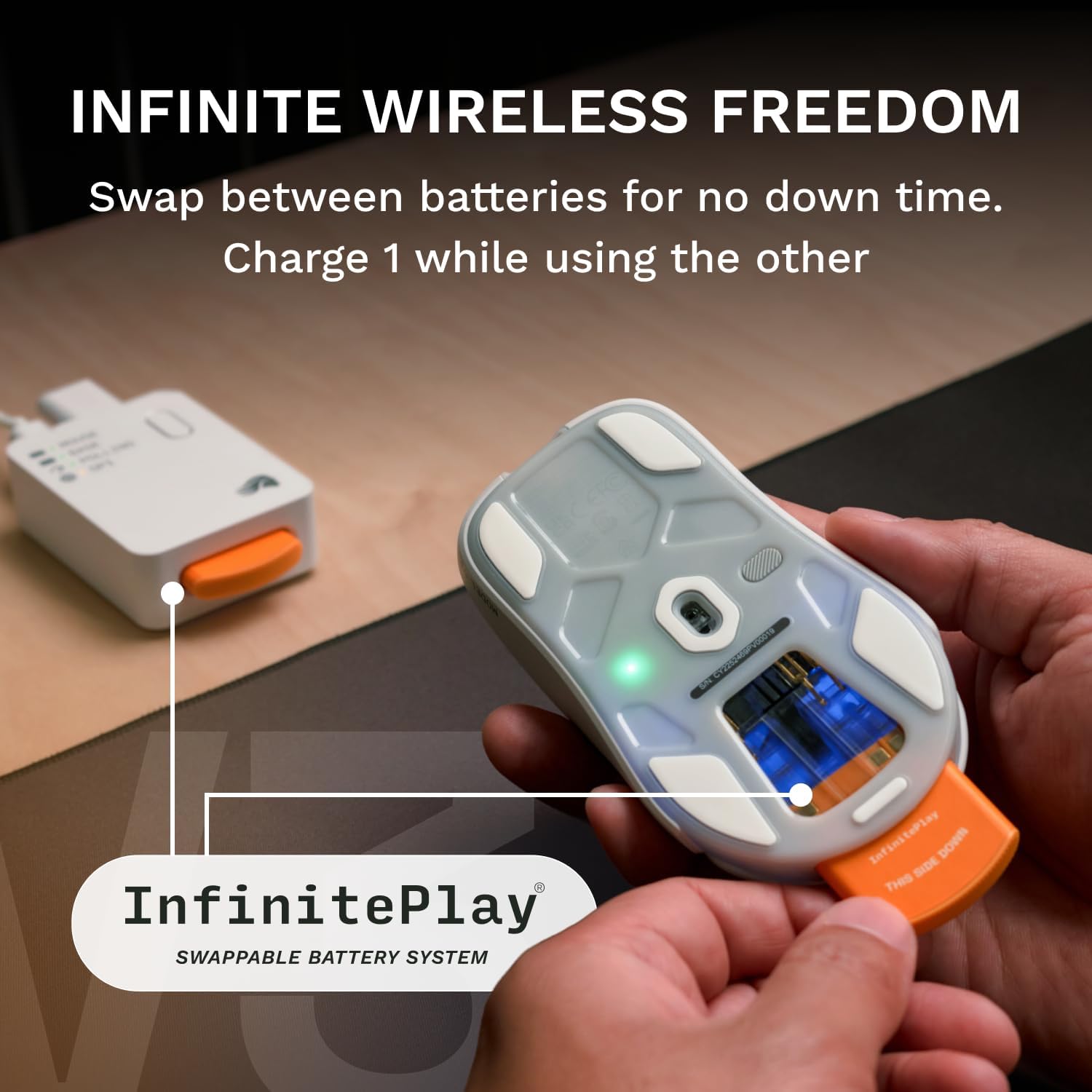
The Model O3 Wireless is Glorious’s most ambitious engineering leap yet. Announced in September 2025, it replaces traditional fixed-battery architecture with InfinitePlay—a hot-swappable LiPo pack system that eliminates mid-session charging entirely. Two included battery packs deliver 130+ hours of combined runtime; swapping takes under two seconds with zero power interruption. The closed-shell 66g body houses the BAMF 3.0 sensor (30,000 DPI / 750 IPS / 50G acceleration), the most capable sensor Glorious has ever shipped, paired with 130-million-click-rated optical switches delivering 0.2ms actuation—zero debounce delay by design.
The integrated InfinitePlay hub doubles as the 8K dongle housing and provides LED readouts for DPI level, polling rate, mouse battery status, and charging pack status. This is the first Model O variant to offer hardware-level battery telemetry without needing the Glorious CORE software open. For competitive FPS players who game in extended sessions—ranked matches, LAN events, 5-hour streaming sessions—the O3 eliminates the only meaningful weakness of wireless gaming: battery anxiety.
| Sensor | Glorious BAMF 3.0 Optical |
| DPI Range | 100 – 30,000 DPI |
| Tracking Speed | 750 IPS |
| Acceleration | 50G |
| Polling Rate | 2.4GHz Wireless 8K Hz · Bluetooth |
| Switches | Optical (130M clicks rated) |
| Weight | 66g |
| Battery System | InfinitePlay Hot-Swap + Guardian 10hr internal |
| Total Battery Life | 130 hours (2 InfinitePlay packs combined) |
| Connectivity | 2.4GHz Wireless + Bluetooth |
| Buttons | 6 programmable |
| Shape | Symmetrical / Ambidextrous |
| RGB | Yes – 16.8M colors via CORE |
| Software | Glorious CORE (Windows) |
Pros
- InfinitePlay eliminates charging downtime permanently
- BAMF 3.0 is the most capable Glorious sensor to date
- 8K polling wireless — best-in-class response latency
- Optical switches with 130M click longevity
- Charging hub provides DPI/polling/battery HUD
- Bluetooth multidevice for non-gaming productivity use
- RGB on a closed-shell ultralight is rare
Cons
- At 66g, not the absolute lightest option available
- Premium price tier for the complete bundle
- Closed shell may run warmer in extended sessions
- CORE software still Windows-only for advanced config
⚡ Best Premium / Esports Pick

Technical Breakdown
The O 2 PRO 4K/8K is engineered specifically for tournament and high-refresh-rate environments where polling architecture directly impacts cursor consistency. In wired mode, 8,000 Hz polling means the host PC receives positional data every 0.125ms—versus 1ms at standard 1K polling. In wireless 2.4GHz mode, 4K polling (0.25ms) still surpasses the wired throughput of most competing mice. The BAMF 2.0 sensor tops out at 26,000 DPI with 650 IPS tracking speed—fully spin-out proof for the flick-heavy mechanics seen in Valorant, CS2, and Apex Legends.
Critically, Glorious eliminated RGB, honeycomb perforations, and Bluetooth connectivity from this model—three architectural decisions that collectively shave 9g versus the standard O 2 Wireless and reduce wireless interference potential to near zero. Motion Sync (synchronizes data transmission to sensor read cycles) is enabled by default for 1K polling but should be disabled at 8K to achieve consistent high-frequency delivery. The 100-million-click optical switches register actuation in 0.2ms, with zero mechanical debounce delay—a genuine competitive advantage in click-timing games.
| Sensor | Glorious BAMF 2.0 Optical |
| DPI Range | 100 – 26,000 DPI |
| Tracking Speed | 650 IPS |
| Polling Rate | Wireless: up to 4K Hz · Wired: up to 8K Hz |
| Switches | Glorious Optical (100M clicks rated) |
| Weight | 59g (Black only) |
| Battery Life | 80 hrs @ 1K Hz · 35 hrs @ 4K Hz |
| Connectivity | 2.4GHz Wireless (4K dongle) + USB-C wired |
| RGB | None (by design) |
| Shell Design | Closed (no honeycomb) |
| Buttons | 6 programmable |
| Shape | Symmetrical / Ambidextrous |
| Motion Sync | Yes (disable at 8K for consistent Hz) |
| Color | Black only |
Pros
- 4K wireless polling rare at this weight class (59g)
- 8K wired polling for maximum tournament-legal performance
- Optical switches — 0.2ms actuation, zero double-click risk
- 80-hour battery at 1K Hz is exceptional
- No RGB = less RF interference, lower power draw
- Motion Sync improves data alignment accuracy
Cons
- No RGB or honeycomb aesthetics (minimalist only)
- Black colorway only limits customization
- 4K/8K polling requires CORE software to unlock
- BAMF 2.0 vs BAMF 3.0 in O3 is a sensor generation behind
💎 Best Value Pick

Technical Breakdown
The Model O 2 Wireless is the sweet-spot option for competitive gamers who want BAMF 2.0 sensor performance, dual wireless connectivity, and RGB—without paying the PRO tier premium. Glorious refined the shell from the V1 Model O Wireless: the honeycomb perforations are slightly smaller for improved structural rigidity, the top-deck texture is grippier, and the split-button architecture prevents pre-travel flex that can cause unintentional double-registration on rapid clicks.
The 26K BAMF 2.0 sensor is among the most accurate sensors Glorious has produced below the O3’s BAMF 3.0, with zero acceleration applied at factory defaults and LOD precision tunable to 0.4mm in Glorious CORE. At 68g and available in black or white, the O 2 Wireless occupies the mainstream competitive tier—a direct answer to Razer’s DeathAdder V3 HyperSpeed and Logitech’s G305 at a lower price-per-feature ratio.
| Sensor | Glorious BAMF 2.0 Optical |
| DPI Range | 100 – 26,000 DPI |
| Switches | Glorious Mechanical (80M clicks rated) |
| Weight | 68g |
| Battery Life | Up to 120 hrs (2.4GHz, RGB off) |
| Connectivity | 2.4GHz + Bluetooth 5.2 |
| Polling Rate | Up to 1,000 Hz |
| Shell | Perforated (smaller hole pattern vs V1) |
| RGB | Yes – 16.8M colors |
| Buttons | 6 programmable |
| Shape | Symmetrical / Ambidextrous |
| Mouse Feet | 100% Virgin PTFE G-Skates |
| Colors | Matte Black / Matte White |
Pros
- Dual wireless (2.4GHz + Bluetooth) for desk versatility
- BAMF 2.0 delivers sub-pixel tracking accuracy
- RGB + honeycomb aesthetic for setup customization
- Best battery life per dollar in the Model O lineup
- Split-button design prevents unwanted click registration
- Available in black and white
Cons
- Capped at 1,000 Hz polling (no high-Hz option)
- Mechanical vs optical switches — higher debounce delay
- 1g heavier than the O 2 PRO (minor but present)
🤏 Best for Small Hands

Technical Breakdown
The Mini is the lightest Model O wireless variant at 57g, making it the choice for fingertip and claw grip players with small-to-medium hands (17–18cm or under). Despite the reduced shell volume, Glorious retained the full BAMF 2.0 sensor suite—same 26,000 DPI ceiling, same LOD precision, same click registration architecture as the standard O 2 Wireless. The shrunk footprint means the scroll wheel, button spacing, and side-button reach are all proportionally tighter.
The standout technical achievement is battery life. With Bluetooth 5.2 at low-power polling, the O 2 Mini Wireless achieves up to 210 hours—the longest runtime in the entire Model O portfolio. At 2.4GHz, expect 80-110 hours depending on RGB state. This makes it ideal for travel setups or desk arrangements where charging access is inconvenient. The dual wireless implementation is identical to the standard O 2: seamless 2.4GHz for gaming, Bluetooth for productivity or multi-device setups.
| Sensor | Glorious BAMF 2.0 Optical (26K DPI) |
| Weight | 57g |
| Battery Life | Up to 210 hrs (Bluetooth) / ~110 hrs (2.4GHz) |
| Connectivity | 2.4GHz + Bluetooth 5.2 |
| Switches | Glorious Mechanical (80M clicks) |
| Polling Rate | Up to 1,000 Hz |
| Buttons | 6 programmable |
| Shell | Perforated compact symmetrical |
| RGB | Yes |
| Target Grip | Fingertip / Claw (small-medium hands) |
| Colors | Black / White |
Pros
- 57g — lightest wireless Model O variant
- 210-hour Bluetooth runtime is category-leading
- Full BAMF 2.0 sensor despite smaller chassis
- Ideal fingertip/claw form factor for smaller hands
- Dual wireless flexibility retained
Cons
- Too small for palm grip users with large hands
- 1K Hz polling cap — no high-Hz upgrade path
- Cramped side-button spacing for larger thumbs
🔋 Best Legacy / Budget Wireless

Technical Breakdown
The original Model O Wireless launched with a compelling premise: an ambidextrous 69g honeycomb wireless mouse with up to 71 hours of battery life at a mainstream price point. It remains available on Amazon and still performs competently for casual-to-intermediate competitive players. The proprietary first-generation BAMF sensor peaks at 19,000 DPI with 400 IPS tracking—competent, but clearly superseded by the BAMF 2.0 and 3.0 generations in spin-out resistance and low-LOD stability.
Omron mechanical switches rated for 20 million clicks power the main buttons—durable but using conventional debounce logic, which introduces 2–8ms of software-side delay versus optical alternatives. The V1’s wireless implementation uses a dedicated 2.4GHz BAMF-optimized receiver with no Bluetooth fallback. For buyers on a strict budget or those who appreciate the V1’s classic honeycomb aesthetic without paying V2/V3 premiums, this remains a functional entry point into the Model O ecosystem.
| Sensor | Glorious BAMF Gen 1 Optical |
| DPI Range | 100 – 19,000 DPI |
| Tracking Speed | 400 IPS |
| Switches | Omron Mechanical (20M clicks) |
| Weight | 69g |
| Battery Life | Up to 71 hours (RGB off) |
| Connectivity | 2.4GHz Wireless only |
| Polling Rate | Up to 1,000 Hz |
| Shell | Classic honeycomb |
| RGB | Yes – 16.8M colors |
| Buttons | 6 |
| Shape | Symmetrical / Ambidextrous |
| Charging | USB-C (play-while-charging supported) |
Pros
- 71-hour battery life still competitive in this class
- Classic honeycomb aesthetic with original Model O DNA
- Play-while-charging via USB-C Ascended cable
- Lowest entry price in the wireless Model O family
- Ambidextrous for left and right-handed users
Cons
- BAMF Gen 1 (19K DPI / 400 IPS) is two sensor generations old
- Omron 20M-click switches show age vs. optical alternatives
- No Bluetooth — single wireless mode only
- Not compatible with Glorious CORE V2 interface (legacy software)
✦ Editor’s Choice – Entry PRO

Technical Breakdown
The Model O 2 PRO 1K is the entry point into the PRO lineup—retaining the optical-switch architecture and no-compromise closed shell of the 4K/8K variant but limiting polling to a standard 1,000 Hz. At 57g, it is among the lightest PRO-tier wireless mice available from any manufacturer. The BAMF 2.0 sensor delivers the same 26,000 DPI and 650 IPS tracking ceiling as the 4K model. Optical switches still register at 0.2ms with no debounce delay—making click latency objectively better than the non-PRO BAMF 2.0 models using mechanical switches, even at matching polling rates.
For players who game in competitive titles but run sub-144Hz monitors or older CPU hardware where 4K/8K polling provides no measurable advantage, the 1K PRO hits the ideal efficiency point. Battery life is also better preserved at 1K polling, with Glorious citing approximately 80 hours of wireless runtime—matching the 4K edition’s best-case scenario while avoiding the CPU overhead of hyper-polling.
| Sensor | Glorious BAMF 2.0 Optical |
| DPI Range | 100 – 26,000 DPI |
| Tracking Speed | 650 IPS |
| Switches | Glorious Optical (100M clicks) |
| Weight | 57g |
| Battery Life | ~80 hours @ 1K Hz |
| Connectivity | 2.4GHz Wireless + USB-C wired |
| Polling Rate | Up to 1,000 Hz |
| RGB | None |
| Bluetooth | None |
| Shell | Closed (no honeycomb) |
| Motion Sync | Yes (enabled by default) |
| Color | Black only |
Pros
- Optical switches at 57g — exceptional weight-to-performance ratio
- 100M click switch longevity vs 20-80M on competing models
- Lower price than 4K/8K edition with same core performance
- 80-hour battery at 1K Hz wireless
- Ideal for 144Hz setups where 4K polling offers no benefit
Cons
- No upgrade path to 4K/8K (different hardware receiver)
- No RGB or honeycomb aesthetics
- Black colorway only — no white option
- No Bluetooth connectivity
🤍 Premium White Esports Option
Technical Breakdown
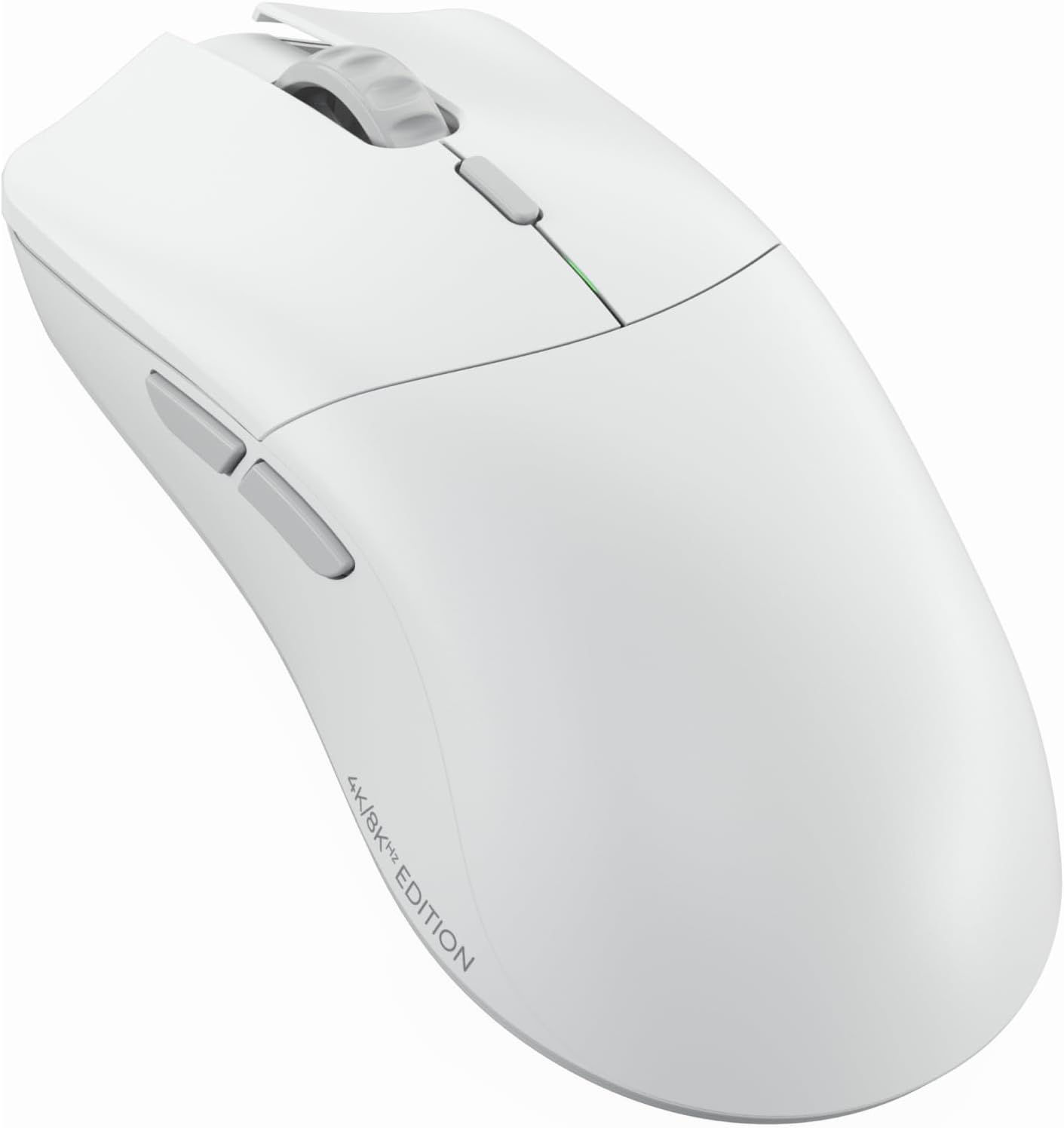
Functionally identical to the Black 4K/8K PRO, the White edition offers the same BAMF 2.0 sensor, optical switch architecture, 59g weight, 80-hour battery, and 4K wireless / 8K wired polling capability. The distinction is purely cosmetic—and meaningful for gamers building all-white setups with white keyboards, white mousepads, or white cases. The closed matte white shell maintains the same slightly roughened grip texture for confident hold without grip tape additions.
For those who want the absolute maximum wireless polling performance available in the Model O ecosystem today (awaiting potential White O3 availability) while maintaining a white aesthetic, this is the only current option. All CORE compatibility, Motion Sync behavior, and polling-rate unlock procedures are identical to the black 4K/8K variant. Note: the White variant may carry a slight price premium over black depending on retailer stock cycles.
| Sensor | Glorious BAMF 2.0 Optical |
| DPI Range | 100 – 26,000 DPI |
| Polling Rate | Wireless 4K Hz · Wired 8K Hz |
| Switches | Glorious Optical (100M clicks) |
| Weight | 59g |
| Battery Life | 80 hrs @ 1K Hz · 35 hrs @ 4K Hz |
| Connectivity | 2.4GHz Wireless (4K dongle) + USB-C wired |
| RGB | None |
| Shell | Closed matte white |
| Colorway | Matte White (only white PRO 4K/8K option) |
| Shape | Symmetrical / Ambidextrous |
Pros
- Only white option with 4K wireless + 8K wired polling in Model O lineup
- Full PRO optical switch + BAMF 2.0 sensor package
- Clean matte white finish for all-white desk setups
- Same 80-hour battery as black 4K/8K variant
Cons
- Functionally identical to black variant — pure aesthetic differentiation
- May carry slight price premium depending on stock
- No RGB despite white shell — harder to show off aesthetically
- BAMF 2.0 still one generation behind O3’s BAMF 3.0
🖱️ How to choose your Glorious Wireless companion
Grip style first: The ambidextrous Model O series (flat, low profile) favors fingertip and claw. The ergonomic Model D series (hump, right-handed) suits palm grips. Weight vs. battery: 55-57g (Eternal/Pro) give you featherlight flicks but smaller batteries. The new Model O 3’s swappable battery eliminates charging downtime – hot-swap in one second.
Polling rate reality: 4K/8KHz reduces latency but consumes more power; you need a CPU with high single-core performance to handle the USB interrupt load. For most, 1000Hz is still flawless. Optical switches (Pro, O3) eliminate double-click issues and offer 100M+ lifespan.
Full Model O Wireless Comparison Table
| Model | Sensor | Max DPI | Max Polling | Switches | Weight | Battery | Bluetooth | Amazon Link |
|---|---|---|---|---|---|---|---|---|
| Model O3 Wireless | BAMF 3.0 | 30,000 | 8K Hz | Optical 130M | 66g | 130H (swap) | ✓ | Buy |
| O 2 PRO 4K/8K (Black) | BAMF 2.0 | 26,000 | 4K/8K Hz | Optical 100M | 59g | 80H / 35H | ✗ | Buy |
| O 2 Wireless | BAMF 2.0 | 26,000 | 1K Hz | Mech 80M | 68g | 120H | ✓ | Buy |
| O 2 Mini Wireless | BAMF 2.0 | 26,000 | 1K Hz | Mech 80M | 57g | 210H (BT) | ✓ | Buy |
| Model O Wireless (V1) | BAMF Gen 1 | 19,000 | 1K Hz | Omron 20M | 69g | 71H | ✗ | Buy |
| O 2 PRO 1K Wireless | BAMF 2.0 | 26,000 | 1K Hz | Optical 100M | 57g | 80H | ✗ | Buy |
| O 2 PRO 4K/8K (White) | BAMF 2.0 | 26,000 | 4K/8K Hz | Optical 100M | 59g | 80H / 35H | ✗ | Buy |
BAMF Sensor Architecture: Generation-by-Generation
| Generation | Max DPI | Tracking Speed | Acceleration | LOD Stability | Power Draw | Used In |
|---|---|---|---|---|---|---|
| BAMF Gen 1 | 19,000 DPI | 400 IPS | 40G | Good | Standard | Model O Wireless V1 |
| BAMF 2.0 | 26,000 DPI | 650 IPS | 50G | Excellent | Optimized | O 2 Wireless, O 2 PRO, O 2 Mini |
| BAMF 3.0 | 30,000 DPI | 750 IPS | 50G | Best-in-class | Ultra-low | Model O3 Wireless |
Expert Buyer’s Guide: What Actually Matters When Choosing a Model O Wireless
Sensor Generation: BAMF 1 vs 2.0 vs 3.0
For competitive players, the sensor generation dictates your ceiling. BAMF Gen 1 tops at 400 IPS—fine for moderate DPI/sensitivity setups, but it will spin out on high-speed wrist flicks at aggressive (800+ DPI × sensitivity) configurations. BAMF 2.0 raises that to 650 IPS, eliminating spin-out for virtually all real-world competitive movements. BAMF 3.0 extends to 750 IPS with improved power efficiency, ensuring the battery penalty for higher-precision tracking is minimized. Unless budget is the primary constraint, BAMF 2.0 or newer should be the minimum target in 2026.
Polling Rate Architecture and When It Actually Matters
Polling rate determines how frequently the mouse reports its position to the PC. At 1,000 Hz, this occurs every 1ms. At 4,000 Hz, every 0.25ms. At 8,000 Hz, every 0.125ms. The measurable advantage is real in controlled tests, but only perceptible during gameplay above 240Hz refresh rates on a capable CPU. For 144Hz gaming, 1K polling is effectively imperceptible versus 4K. Invest in higher polling only if your monitor and CPU can leverage it—otherwise the battery impact at 4K Hz (35 hours vs 80 hours on the O 2 PRO) offers no gaming benefit.
Optical vs Mechanical Switches: The Debounce Debate
Glorious Mechanical switches use hardware debounce logic to prevent double-click registration—adding approximately 2–8ms of post-actuation delay. Optical switches (available on all PRO variants and the O3) bypass debounce entirely, registering clicks via infrared beam interruption in 0.2ms. In click-timing games—battle royale, FPS, MOBAs with frame-perfect ability timing—optical switches provide a genuine and measurable advantage. For general productivity or casual gaming, mechanical switches are entirely sufficient and offer more tactile feedback nuance.
InfinitePlay vs Fixed Battery: Long-Session Gaming
The Model O3’s InfinitePlay hot-swap battery system is a genuine quality-of-life breakthrough. Fixed-battery mice (all other Model O wireless variants) require a USB-C charging cable during recharge, effectively converting them to wired mice temporarily. With InfinitePlay and two battery packs, you charge one pack in the hub while gaming on the other, eliminating cable time entirely. For LAN events, content creators, or marathon sessions, this is a meaningful real-world advantage, not just a spec sheet entry.
Shell Design: Honeycomb vs Closed
Honeycomb perforations directly reduce shell weight, improve airflow over the hand, and allow internal RGB light bleed that enhances visual customization. However, perforations also allow dust, debris, and sweat ingress into the sensor well and switch cavity—requiring periodic cleaning. PRO-series closed shells weigh marginally more but offer better long-term component protection and cleaner aesthetics for white setups. Players with sweaty palms often prefer closed shells for the additional grip provided by matte surface textures.
Ergonomics by Hand Size and Grip Style
The entire Model O wireless lineup uses a symmetrical ambidextrous shape—optimal for palm, claw, and fingertip grips from either hand. For hand sizes below 18cm, the O 2 Mini’s compact form is the clear choice. For 18–20cm hands, any standard Model O wireless variant provides comfortable palm coverage. For hands above 20cm, the slight rear hump of the O 2 Wireless and O3 may feel compact; extended palm-grip users in this range should verify dimensions before purchasing or consider the Model D series for ergonomic right-hand shaping.
Glorious Wireless Mouse FAQ (2026)
What is the lightest Glorious Model O Wireless mouse available?
Is the Glorious Model O3 Wireless worth it over the Model O 2 Wireless?
What polling rate do I need for competitive FPS gaming in 2026?
Can I use the Glorious Model O 2 PRO on Mac?
What is Motion Sync and should I disable it at 8K polling?
How does InfinitePlay work on the Model O3 Wireless?
Are Glorious Model O wireless mice good for palm grip?
What accessories are compatible with Model O wireless mice?
Should I buy the Model O Wireless V1 or upgrade to Model O 2 Wireless?
Is the Glorious BAMF sensor better than PixArt PAW3395?
Q: Does the Model O 2 Pro work without holes?
Q: Can I use Glorious mice with Bluetooth?
Q: How long does the swappable battery last in O 3?
Q: Which Glorious mouse is best for small hands?
Q: Are optical switches better than mechanical?
Q: Does Glorious Core software run on macOS?
Q: What is the real-world latency of 4KHz mode?
Q: Which model has the longest battery life?
Q: Are there any known durability issues?
Final Verdict: Best Glorious Model O Wireless for Every Player Type
The Glorious Model O wireless lineup in 2026 covers more competitive ground than any single competitor’s equivalent family. Whether you’re a pro-circuit player demanding sub-0.25ms optical switches and 8K polling, a budget-conscious FPS player entering the ultralight ecosystem for the first time, or a long-session streamer who refuses to manage charging cables—there is a purpose-built Model O wireless variant for your specific requirements.